

How Can Corporate AI Training Benefit Your Company?
As AI technologies become deeply embedded in business operations, there’s a growing urgency for corporate AI training programs. But what exactly does “AI corporate training” entail, and how does it differ from general tech training or individual online courses?
In a corporate setting, AI training is typically an employer-driven initiative to educate and skill-up groups of employees (or even the entire company) in artificial intelligence tools, principles, and project implementation, all tailored to the company’s specific context.
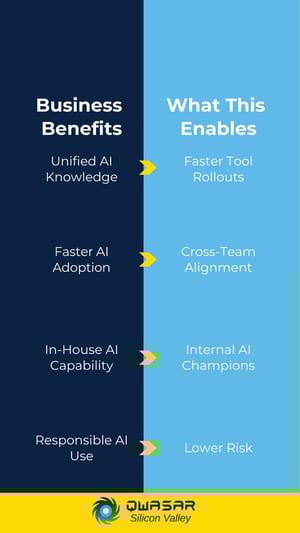
The benefits of undertaking such an initiative are multifold:
- Unified Knowledge Base
Training at scale ensures that teams share a common understanding of AI. This is crucial if you plan to roll out AI-driven tools company-wide. Instead of a few experts siloed in IT or data science departments, corporate training brings a broad swath of employees up to a baseline of AI literacy and capability. That means when new AI projects or processes are introduced, there’s less friction and more collaboration across departments, because everyone speaks the same language and knows the fundamentals. - Faster AI Adoption
With a trained workforce, implementing AI solutions becomes faster and smoother. Employees won’t be intimidated by new AI software or workflows; instead, they’ll be able to onboard and start using them effectively. A McKinsey study emphasizes that treating AI adoption as a journey of upskilling and culture change leads to much higher success rates. Corporate AI training catalyzes this by preparing the ground, your workforce becomes change-ready and even enthusiastic about AI, rather than resistant. - In-house Expertise Development
Relying solely on hiring external AI experts can be costly and insufficient given the demand. By training your existing employees, you develop in-house AI champions who understand both the technology and your business. They can start leading AI projects internally, which is often more sustainable than consulting-based approaches. Plus, those employees feel valued and are likely to stay and grow with the company, mitigating talent shortages. - Ethical and Responsible AI Use
A sometimes overlooked aspect – corporate AI training is an opportunity to instill your company’s values and policies regarding AI use. Topics like data privacy, security, and AI ethics (avoiding bias, ensuring transparency) can be built into the curriculum. This way, as your workforce deploys AI, they do so responsibly. Given increasing regulations and public scrutiny around AI (e.g., concerns about how AI might misuse data or make unfair decisions), having a workforce educated in AI ethics is a smart risk mitigation. For instance, PwC’s company-wide AI training included segments on using AI tools ethically and responsibly, underscoring the importance of this at the corporate level.
Designing an Effective AI Corporate Training Program
When rolling out AI training in a corporate environment, planning and design are key. Here’s a step-by-step look at how a company might design an effective program:
- Set Clear Objectives
Determine what you want to achieve. Is the goal to have a handful of specialists who can build AI models? Or do you want every employee to understand how AI can assist in their role (AI literacy for all)? Perhaps you aim to develop a new AI-powered product and need your software teams deeply skilled. Defining the scope (breadth vs. depth) will shape the program content. - Choose the Right Training Partner or Platform
You could build an internal training from scratch, but that’s often impractical for most companies. Instead, evaluate external programs like Qwasar’s or others that specialize in corporate AI training. Look for those that can tailor content to you, and have proven success with corporate cohorts. Remember, corporate training isn’t just about content quality, but also about project management – you need a partner used to dealing with groups of professionals and corporate expectations (reporting progress, adjusting to feedback, etc.). - Pilot the Program
It can be wise to start with a pilot group before scaling to the whole company. Choose a department or a mix of employees to go through the training first. This pilot will give you insights into what works and what might need tweaking. For example, you might discover that weekly sessions should be held on Wednesdays instead of Fridays for better attendance, or that employees need an extra week on a particularly challenging module. After the pilot, gather feedback and measure results (did the participants improve their skills? are they using those skills?). - Scale Up with Cohorts
With lessons learned from the pilot, roll out the training to larger groups. Creating cohorts (groups) that go through training together is effective – it builds camaraderie and peer learning. Some companies create cross-functional cohorts intentionally, so that, say, marketing and operations folks learn together; this can spark cross-pollination of ideas about AI use-cases in the organization. - Blend into Work Routines
Corporate training works best when it’s integrated rather than seen as a disruptive add-on. If possible, allocate work time for the training. The Option 1 vs Option 2 scheduling from Qwasar is a good example: if weekly 1-hour sessions are used, those could be part of an employee’s work calendar, with manager approval that a few hours per week can be spent on the project. If the intensive half-day workshop model is chosen, perhaps those days are arranged as “Training Fridays” for a month. By formally recognizing training time, you signal its importance and help employees manage their time. - Leverage Internal Advocates
Encourage those who finish the training (especially pilot participants or early cohorts) to become internal advocates or even mentors for others. They can share success stories of how they applied AI in their tasks, help colleagues troubleshoot issues, and maintain momentum for the initiative. This peer support can sustain the training program’s impact well beyond the official end of the course.
Build AI Readiness Into Your Workforce
AI is becoming central to business strategy and operations. Preparing your workforce with corporate AI training is no longer a luxury but a strategic investment. With thoughtful program design, the right training partner, and clear objectives, companies can develop internal AI capability that fuels innovation, boosts efficiency, and supports responsible AI adoption.
The future of work is AI-enabled. The sooner your organization equips its teams, the greater your advantage.