
The phrase corporate AI training is everywhere, yet most engineers still avoid internal courses because they’re lecture-heavy, tool-light, and loosely connected to real work. If you want adoption, choose corporate AI training that treats engineers like builders, not viewers.
The adoption triangle: relevance, practice, resources
Engineers already have a head start when it comes to AI adoption. They understand how computers work, have grounding in statistics, and are fluent in programming. As a result, AI training for engineers must respect that baseline. Vague, non-technical courses waste time; effective programs empower engineers to actively build with AI.
For engineers, corporate AI training generally falls into two categories:
- Driving adoption of AI tools
- Developing technical capability to build AI-powered applications, agents, or agentic systems
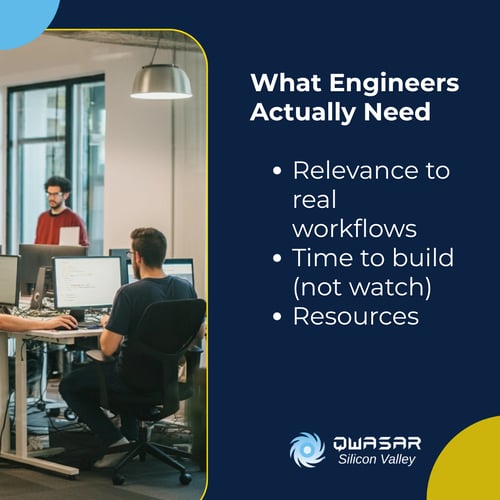
In both cases, successful corporate AI training must deliver three things:
- Relevance: Projects tied directly to your backlog or real workflows
- Practice: Time-boxed build sessions, pair programming, and code reviews
- Resources: Demos and capstones leaders can evaluate, and teams can extend
Qwasar’s programs are structured around this adoption triangle, whether you’re running a 6-week department course or a 12-week engineering track.
What engineers need from corporate AI training
Engineers are builders by nature. They learn through doing, not by watching. As a result, lecture- or video-based AI training is often a poor investment.
Research highlighted by Harvard Business Review shows that much L&D spending is wasted when training is theoretical and unused within days. Skills that aren’t applied quickly fade.
The most effective AI training environments for engineers simulate real engineering work:
- Production-like constraints: Latency budgets, data boundaries, and measurable quality bars
- Stack alignment: Your cloud provider, vector stores, orchestration tools, and models
- Peer review: Feedback loops that reflect your engineering culture
- Autonomy by the end: Confidence to design, build, and ship the next iteration independently
Customization is where ROI lives
Once relevance, practice, and resources are in place, customization becomes the biggest driver of ROI. While generative tools make customization easier than ever, not all training providers are willing to tailor programs.
Training aligned to your goals, outcomes, tech stack, and real use cases allows engineers to apply skills immediately. When learning connects directly to daily work, new habits form quickly—and ROI follows.
Your corporate AI training should align with:
- Your stack: AWS Bedrock vs. Vertex, embeddings libraries, orchestration frameworks, hosting, model choices, and monitoring tools
- Your use cases: Voice agents, policy retrieval systems, sales research copilots, internal support assistants, and more
- Project selection: Choice of projects or the ability to design new ones tailored to your needs
Qwasar’s Course Catalog
Qwasar offers a range of corporate AI training programs, most of which are customized by duration, content, industry, and format:
- Agentic AI for Engineers (12 weeks, part-time): Build and evaluate agentic systems, tools, and guardrails
- AI Applications Developer (12 weeks, part-time): LLM integration patterns, RAG architectures, and tuning strategies
- Agentic AI for Your Departments (6 weeks): Targeted agents and copilots for business workflows
- Introduction to Agentic AI (2 × 1-hour sessions): Fast alignment for leadership and broad teams
Condensed 3–6 week courses are also available, depending on audience and training needs.
The cost of corporate AI training programs
Corporate AI training prices vary widely—from low-cost lecture-based MOOCs to $15,000 per participant for fully custom, in-person sessions. Most organizations don’t have that level of budget per engineer.
With average L&D budgets often under $2,000 per person, companies gravitate toward MOOCs. However, these rarely equip engineers with the skills needed to deliver production-ready AI systems.
At Qwasar, corporate AI training programs typically range from $500–$1,500 per participant, depending on format, duration, cohort size, and subject area.
The question to settle
Will your corporate AI training produce artifacts your teams can extend in the next sprint? If yes, training is working. If not, you’re buying content, not capability.
CTA: Ready to launch corporate AI training that engineers will actually use? Share your stack, target use cases, and preferred cadence—we’ll design a cohort plan that fits.